Showing posts with label Fertilizer Scam. Show all posts

Saturday, July 27, 2013

PolEco: The mother of all scams: Napoles' P10-B scam (from the Inquirer News website (last of a series)

Napoles: We control gov’t

Kidnapping led to discovery of P10B pork scam

By
 
(Last of a series)
 
When agents of the National Bureau of Investigation swooped down on March 22 on a condominium unit in the swank South Garden Pacific Towers in Taguig City and rescued Benhur Luy, little did they know that they were to pry open a Pandora’s box of ghost projects worth P10 billion over the past decade.
Following days of surveillance on orders of Justice Secretary Leila de Lima and NBI Director Nonnatus Rojas, the special task force headed by Regional Director Rolando Argabioso rescued the 31-year-old Luy, who had been reported by his lawyer, Levito Baligod, as missing by his parents, Arturo and Gertrudes.
Baligod’s letter dated March 1, asked De Lima’s help in locating Luy, who the lawyer said had been detained by his employer and cousin Janet Lim-Napoles and her brother Reynald Lim.
Luy’s parents said that Lim had warned them not to go to authorities for assistance, telling them, “Hawak namin ang gobyerno (We control the government).”
Napoles, president and CEO of the trading firm JLN, was alleged to be the brains behind the multibillion-peso racket using mainly pork barrel funds, or the Priority Development Assistance Fund (PDAF), of five senators and 23 members of the House of Representatives for nonexistent projects. She has denied any wrongdoing.
In his letter to De Lima seeking assistance, Baligod said:
“This case initially appeared to me as simple case of serious illegal detention. However, a further interview of witnesses revealed that the victim was being detained to ensure that nobody could directly implicate the above persons with the ongoing issues on the fertilizer scam, Malampaya Fund, and anomalies in the implementation of several PDAF-funded projects.”
A medical technology graduate, Luy joined Napoles, a distant cousin, in September 2002 and became her personal assistant. There was a falling out, after Napoles claimed that he took an unauthorized loan of P5 million and ran away with P300,000 he was ordered to deposit in her account.
After his rescue, Luy prepared a statement for the NBI detailing where he was detained by Napoles and her brother.

Ordeal begins
On the first day, Luy said he was kept in one of the rooms of the Discovery Suites at Ortigas Center in Pasig City, but all outside calls were barred by the hotel on orders of Napoles.
Before he was detained, he said Napoles took his pouch that contained his driver’s license, PRC identification card, credit cards, ATM cards, passport, various bank passbooks, check booklets and cash. While Napoles was talking to Luy, her security escorts surrounded him.
On the second day, Luy said he was brought to Bahay San Jose at No. 52 Lapulapu St., Magallanes Village, Makati City, where  Msgr. Josefino Ramirez and five Chinese priests were staying. There, Luy said he was also barred from using cellular and landline phones.
He was also told not to speak to the two security guards and was prohibited from watching television. More importantly, he was barred from going out of the house and his movements were being jotted down on the guard’s logbook.
He said that he was able to get out of the house on Dec. 24, Jan. 9, and Feb. 23 but under escort by Lim and his aides. Every time there was a visitor in the priests’ residence, he was told to hide in the chapel. He said that in the three months that he stayed with Monsignor Ramirez, “he spoke to me only three times” but that he was unable to speak about his plight.

Described as a drug addict
Luy said that his captors, during his detention, pictured him as a drug addict who had to be reformed. Luy said that his family pleaded with Lim to let them see him at least.
“But instead Lim told us that we can see him if they surrender to him the laptop he was using and not to report anything to authorities because hawak nila ang gobyerno,” Luy said in his affidavit.
Surrendering the laptop containing business transactions of JLN Corp., the mother said, was the condition set by the siblings for them to see Benhur.
On Dec. 21, based on the affidavit of Luy’s mother,  Lim got the laptop from her and told her not to report to authorities, repeating, “Hawak namin ang gobyerno.”
According to an affidavit of Luy’s friend, Flor Villanueva, who had possession of the laptop, she was able to copy all the files before it was given to Lim.
In his third meeting with his family on Feb. 23, Luy said he was able to sneak a note to his sister, Annabelle, asking for help.

Personal bank accounts
Benhur in his affidavit said that Napoles cleaned out his personal bank accounts through illegal and unauthorized withdrawals while he was under detention.
He claimed that his personal accounts with United Coconut Planters Bank  and Metrobank that reached P1.5 million were withdrawn through a debit memo. He added that his dollar account with a balance of $13,000 was closed with the full amount withdrawn.
“All this I earned in the 10 years of working with JLN,” he said.
The NBI said that the operation to rescue Luy began on March 8. When it was carried out, Lim was arrested but Napoles eluded the agents. Lim was taken to St Luke’s Medical Center at Global City after he complained of chest pains. He subsequently had heart surgery.
Luy told the NBI that during his detention he was moved from one place to another—all owned by Napoles—during the day, but was returned to Bahay San Jose to spend the night.
He said he was detained in houses located in an upscale subdivision, high-end condominiums, and a retreat house run by retired priests.
In his narration to the NBI, Luy claimed there was not a moment while he was detained that he had the chance to escape. He said Lim was always with him “when I go out of the residence of the priest, and he was always nearby listening when I talked to my family.”
The NBI recommended the filing of kidnapping charges against Napoles and Lim in March. The charges were dismissed on June 10 by Assistant State Prosecutor Juan Pedro Navera. Now Luy stands accused of qualified theft and no bail is recommended.


Wednesday, July 24, 2013

PolEco: The mother of all scams: Napoles' P10-B scam (from the Inquirer News website (fifth of a series)

Malampaya fund lost P900M in JLN racket

Fake NGO got money for agrarian reform

By

 
(Fifth of a series)
 

PRE-FALLOUT Whistle-blowers Benhur K. Luy, former personal assistant of Janet Lim-Napoles, and Marilyn Suñas pose in this undated photo taken at the JLN Group of Companies office at Discovery Suites in Ortigas Center, Pasig City. CONTRIBUTED PHOTO

At least P900 million from royalties in the operation of the Malampaya gas project off Palawan province intended for agrarian reform beneficiaries has gone into a dummy nongovernment organization (NGO), according to an affidavit on a P10-billion racket submitted to the National Bureau of Investigation (NBI).
“There were no deliveries of supplies for listed beneficiaries for the Malampaya funds,” according to the document executed by Marilyn Suñas, one of six whistle-blowers on the alleged scam said to have been carried out by Janet Lim-Napoles, president and CEO of JLN Corp. that is being investigated by the NBI.
Affidavits earlier made available to the Inquirer and interviews with whistle-blowers indicate that a large portion of the multibillion-peso scam over the past 10 years allegedly masterminded by Napoles came from the Priority Development Assistance Fund of Senators Ramon Revilla Jr., Juan Ponce Enrile, Jinggoy Estrada, Ferdinand Marcos Jr. and Gregorio Honasan and 23 members of the House of Representatives.
All the senators denied involvement in the racket involving ghost projects and 20 bogus NGOs.
Suñas, 59, said she was assigned by Napoles as president of People’s Organization for Progress and Development Foundation Inc. (POPDFI). She claimed that apart from being assigned as head of the dummy NGO, she also acted as the project coordinator of JLN and the Department of Agrarian Reform (DAR) in the Malampaya fund project.
 The DAR, then headed by Secretary Nasser Pangandaman, was the implementing agency of the oil funds. His assistant secretary, Narciso Nieto, was the signatory of the tripartite memorandum of agreement (MOA) for the distribution of the P900 million funds from Malampaya.
Other signatories of the MOA were local government units involved in the Comprehensive Agrarian Reform Program (CARP), which has been underfunded and which has forced many beneficiaries to sell their lands.
“The NGO head and Nieto’s signature were genuine, but the LGU official’s signature was forged,” she added.
Suñas explained that the LGU was supposed to be the recipient of the agricultural kit supposedly supplied by the dummy NGO.
“But no delivery was ever made, all the receipts were manufactured for the liquidation of the funds,” Suñas said.
When asked by the Inquirer if Pangandaman and Nieto were involved in the scam, Suñas said: “Based on the vouchers received by the NGO, they were also the signatories. We do not know what is the agreement between them and Ma’am Janet.”

Dummy NGOs
She added that 12 dummy NGOs were made recipients of the Malampaya funds.
These were Bukirin Tanglaw Foundation, Karangyaan para sa Magbubukid Foundation, Masaganang Buhay Foundation, Tanglaw para sa Magsasaka Foundation, Kasaganahan para sa Magsasaka Foundation, Kaupdanan para sa Mangunguma Foundation, Micro-Agri Business Citizens Initiative, Dalampan San Amon Utod Foundation, and Ginintuang Alay sa Magsasaka Foundation, Karangyaan para sa Magbubukid, People’s Organization for Progress and Development and Abundant Harvest for People’s Foundation.
Suñas said that based on the MOA, the NGOs were supposed to deliver agricultural packages that were also bought from JLN companies, the Jo Chris Trading and TNU Trading. Suñas maintained that the money received by the NGO was all remitted to Napoles, who has denied any wrongdoing.
Pangandaman and Nieto were not immediately available for comment.
Agrarian Reform Secretary Virgilio de los Reyes said that even before the issue on the Malampaya fund broke out, the Commission on Audit had created a team to look into the matter.
De los Reyes told the Inquirer that for the past four or five months, a COA special audit team had been looking into the fund.
The agrarian reform secretary said that he was waiting for the results of the audit and the COA recommendation, adding, “We will proceed from there.”

Monday, July 22, 2013

PolEco: The mother of all scams: Napoles' P10-B scam (from the Inquirer News website (fourth of a series)

28 solons linked to scam

Revilla gave pork to syndicate 22 times

By


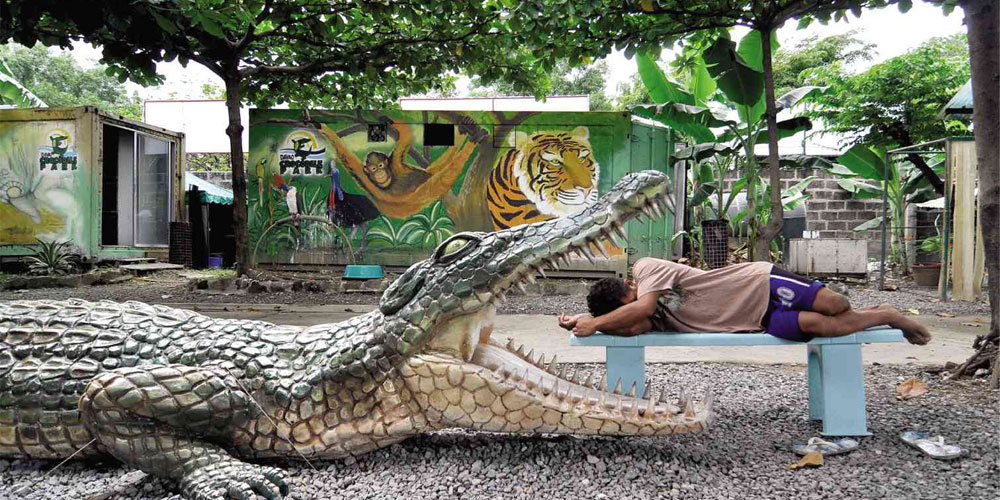
UNFAIR TO CROC Animal lovers say it’s unfair to compare the crocodile to greedy lawmakers who allegedly get hefty kickbacks from a syndicate that funnels their funds to ghost projects. Photo shows a zookeeper taking a morning nap beside a concrete replica of a croc at Crocodile Park in Pasay City. RICHARD A. REYES

(Fourth of a series)

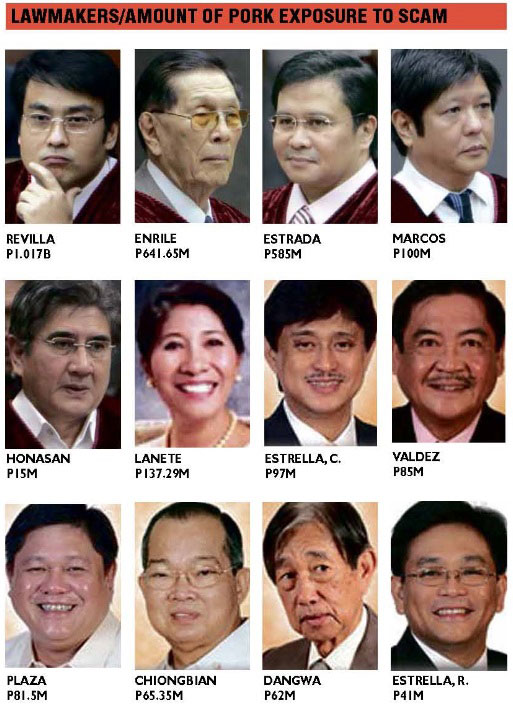
Five senators and 23 members of the House of Representatives allegedly made available their pork barrel funds to dummy nongovernment organizations for purported ghost projects worth P10 billion over the past decade, according to affidavits submitted to the National Bureau of Investigation.
Sen. Ramon “Bong” Revilla Jr. topped the list of lawmakers who were said to have allowed the use of their Priority Development Assistance Funds (PDAF) to the scheme allegedly hatched by Janet Lim-Napoles, president and CEO of the trading firm JLN Corp., according to the documents secured by the Inquirer.
Revilla gave the syndicate access to his PDAF, or pork barrel, to dummy NGOs formed by Napoles and registered in the Securities and Exchange Commission in 22 instances; followed by Senators Juan Ponce Enrile on 21 occasions; Jinggoy Estrada, 18 times; Ferdinand Marcos Jr., four; and Gringo Honasan, once with a small amount.
Contrary to one newspaper report, Sen. Loren Legarda was not involved in the scam, said the principal whistle-blower, Benhur Luy, a former Napoles employee. “There was an attempt, but I heard she was dropped because she scrutinized it and she was very keen on receipts,” Luy told the Inquirer.

Seachon-Lanete
Topping the list of 23 House representatives is Rizalina Seachon-Lanete of Masbate’s third district, who allowed her pork to be used 13 times; followed by Conrado Estrella III of Pangasinan’s 6th district and Rodolfo Plaza of Agusan del Sur, both nine occasions; and Samuel Dangwa, of Benguet, eight.
Contacted by the Inquirer last week, Estrada said he would comment after he had read the affidavits secured by the NBI and had enough background information on the subject. Enrile and Revilla were not immediately available at the weekend but were expected to likewise respond to the issues raised against them.
Faced with a similar issue on their pork barrel funds going to spurious projects of bogus NGOs a few months back, Estrada called for an investigation into who could have unduly benefited from the scam.
All three senators earlier acknowledged that they had identified agriculture projects that were funded by their pork but denied any knowledge that an NGO that handled the funds was a bogus organization.
The three had asked the Department of Agriculture to shed light on how the concerned PDAF funds released between 2009 and 2010 were actually spent.
Reached by phone last week, former Rep. Arthur Pingoy asked where the PDAF was supposedly sourced from. He asked for details about the JLN company and said he would have it checked. He said he would then get back to the Inquirer.

‘Nothing to do with that’
Rep. Victor Ortega said: “I have nothing to do with that. I did not receive a single sack of fertilizer nor received a single peso from the fund for the fertilizer. The accuser should face me and tell me personally.” He said of Napoles: “I have never met her nor talked to her. I do not know her.”
Each senator has a PDAF budget of P200 million annually; congressmen each have a P70-million pork allocation, but during the Arroyo administration, favored senators and congressmen received more than they were supposed to get. Under the law, the lawmakers have the sole discretion in the disposition of their pork barrel.
Based on the documents obtained by the Inquirer, Enrile, at one time, downloaded P111 million of his PDAF to three dummy NGOs on the same date. Of the total amount, only P35 million allegedly went to the Napoles NGOs.

LGU involvement
A total of P3 billion was on the whistle-blowers’ list for the years 2006-2011. Implementing agencies for this total amount were the National Livelihood Development Corp. and the Technology Resource Center.
Apart from the 20 dummy organizations, the list also showed that 30 local government units were recipients of the pork barrel. However, according to the whistle-blowers, there were LGUs that were not aware of the funds and did not receive a single centavo.
The whistle-blowers also identified banks where the accounts of the bogus NGOs were deposited.

Banks
Deposits were made in the following banks:
– Metrobank, Magdalena branch in Binondo, Manila—Bukirin Tanglaw Foundation, Social Development Program for Farmers Foundation, Gintong Pangkabuhayan Foundation, Kasaganahan para sa Magsasaka Foundation, Tanglaw para sa Magbubukid Foundation, Ginintuang Alay para sa Magsasaka Foundation, Micro-Agri Business Citizens Initiative Foundation, Karangyaan para sa Magsasaka Foundation and Saganang Buhay Foundation.
– Metrobank, Jose Abad Santos branch—Philippine Agri and Social Economic Development Foundation.
– LandBank, Greenhills branch—Social Development Program for Farmers Foundation, Masaganang Ani para sa Magsasaka Foundation and People’s Organization for Progress and Development Foundation.
– LandBank, Department of Education branch in Pasig City—Countrywide Agri and Rural Economic Development Foundation, Agri and Economic Program for Farmers Foundation, Agrikultura para sa Magbubukid Foundation, Kasaganahan para sa Magsasaka Foundation and Dalampansang Amon Utod Foundation.
– Metrobank, Ortigas Center branch—Kaupdanan para sa Mangunguma Foundation and Abundant Harvest for People Foundation.

Napoles bank accounts
Luy, the whistle-blower, said he also opened bank accounts in Napoles’ name and deposited there cash taken from the NGO accounts.
Among the bank accounts of Napoles that Luy identified were UCPB Makati head office, Metrobank on Jose Abad Santos, Ortigas and Magdalena in Binondo, Metrobank Ortigas Center for JLCN Global Properties.
The whistle-blowers said portions of the illegally acquired funds were deposited in the accounts of various persons that earned interest in connivance with the Air Materiel Wings Savings and Loan Association Inc. (SMWSLAI).
“There are existing accounts of other people with AMWSLAI where she put the money and withdraw them through the help of some officials there,” one of the whistle-blowers said. “She can deposit and withdraw money from someone else’s accounts without the knowledge of that person that his account is being used by Napoles.”

Properties
The whistle-blower also identified properties supposedly acquired by Napoles in the course of her illegal activities: houses and lots located at high-end subdivisions like Forbes Park in Makati, Ayala Alabang Village, the whole 25th floor of Discovery Center in Pasig City, units in Serendra and Pacific Plaza Towers (18-B and South Garden Unit) and AFPVOI Village (lots only).
Also identified were expensive vehicles of Napoles supposedly acquired through the money: Range Rover (PN TIN 11), white Porsche Cayenne (CYN 98), white Toyota Alphard, BMW, Tahoe, Chevrolet, two Ford E-150, Starex Gold,  Toyota Prado, Savanna GMC, Lincoln Navigator, Hummer, Land Rover, Honda Civic and Mercedez Benz


Sunday, July 21, 2013

PolEco: The mother of all scams: Napoles' P10 -B scam (from the Inquirer News website) (third of a series)

How P10-B racket works

‘As long as gov’t is there, there’s money’

By , Nancy C. Carvajal
 
(Third of a series)

Using just a list of bogus recipients and foundations, and forged signatures of local officials, a small company has allegedly converted billions of pesos in government funds into kickbacks.
For nearly a decade, Janet Lim-Napoles and her company, the JLN Group of Companies, had been running the alleged racket with the complicity of officials, including legislators, and had gotten away with it because of her extensive connection in the government, her former employees said.
The scheme involved the Malampaya funds, the fertilizer fund and the lawmakers’ allotments from the priority development assistance fund (PDAF), or pork barrel.
“She’d tell us that as long as the government is there, there’s money,” Napoles’ former aide, Arthur Luy, told the INQUIRER.
Napoles and her company had been trading agricultural products since 2000 until she reportedly discovered in 2003 a quicker scheme to make money, her former employees said in interviews and affidavits submitted to the National Bureau of Investigation, which is looking into her activities.
For such a high-stakes racket, the modus operandi was surprisingly simple, the INQUIRER has learned.
Napoles, who allegedly ran the racket from unit 2502 of Discovery Suites in Ortigas Center, Pasig City, established foundations or nongovernment organizations (NGOs) to serve as recipients of the funds and named her own employees, including a nanny, as presidents of these outfits.
The funds, which were deposited in the foundations’ bank accounts, were eventually remitted to her to be split between her and the lawmaker whose PDAF allotment was used, or the official of the state agency involved.
The first step was to identify the source of fund, such as the pork barrel.
Napoles talked to senators
Either JLN staff would write a lawmaker requesting funding, say for the purchase of farm inputs on behalf of mayors or governors, or the lawmaker himself would indicate that his pork barrel be allocated to an agency, say the Department of Agriculture (DA).
It was Napoles who would talk to the senator, or his or her chief of staff, according to Merlina Suñas, JLN’s former account executive.
For good measure, the letters forwarded to the lawmaker’s office bore the scanned letterhead of the mayor’s or governor’s office, and the official’s forged signature.
Once everything was cleared, the staff would convince local governments to agree that the fund be released into preidentified foundations or NGOs with the promise of commission. The Department of Budget and Management would then issue a special allotment release order (Saro) to be charged against the lawmaker’s PDAF allocation, and later the notice of cash allocation (NCA), to the agency upon the submission by the lawmaker of a list of beneficiary-agencies.
Special projects team
The NCA was “good as cash.” The money would then be deposited in the account of the foundation and be withdrawn in favor of JLN.
“After we had delivered the money, we didn’t know what happened,” said Merlina Suñas, 59, president of the People’s Organization for Progress and Development Foundation Inc. (POPDF).
Suñas was part of JLN’s “special projects” team that carried out the alleged racket. And part of her job was to form a foundation, whose name she had pieced together by Googling, and drew up a list of fictitious beneficiaries, and withdrew the money and delivered it to Napoles.
‘Everything is forged’
A communication from a senator indicating that his or her PDAF fund be allocated to an agency, say, the DA, would start the ball rolling.
The team would prepare the paper work, such as a memorandum of agreement, a project proposal and a letter for financial assistance from a mayor to the secretary of agriculture. Napoles’ personal assistant Benhur K. Luy would sign as the “mayor,” Suñas said.
“Everything is forged,” Arthur Luy said. “The mayor was unaware of such a project and that there were funds for this.” (Arthur and Benhur Luy are brothers.)
The requested “fund assistance” would range from P1.5 million to P10 million.
“We only wait for the Saro. Once we get a copy, that’s the time we determine the beneficiaries of that senator. If the senator says the PDAF should go to the LGU, then we identify a municipality,” Suñas said.
 
Dummy foundations
In other instances, the senator would write the mayor endorsing a certain foundation to implement, say, a P5-million project from his or her PDAF fund.
As she had done to other “original” employees, Napoles named Suñas as president of the POPDF, a dummy foundation registered with the Securities and Exchange Commission to act as recipient of the funds.
In the instances where POPDF was named recipient, Suñas withdrew the money from a bank in Greenhills, San Juan City, and delivered it to Napoles in her office or at home.
“We called it ‘going to market.’ We’d stuff the money into a Samsonite traveling bag,” she said. “The tellers knew me; they called me by my first name. They’d ask, ‘Where did this come from?’ We’d tell them it’s payment for supplies.” On one occasion, she withdrew up to P30 million.
Suñas confirmed that in 2012 her foundation received P5 million in pork barrel funds from each of then Senate President Juan Ponce Enrile, Senate President Pro Tempore Jinggoy Estrada and Senate Majority Leader Vicente Sotto III, and the Dinalupihan municipal government in Bataan was used as a conduit.
Once the money was downloaded, a memorandum of agreement was signed between the foundation and the local government for the delivery of farm inputs, she said.
Paper implementation
Following the agreement, P15 million worth of fertilizer was delivered to the municipality, she said. “We delivered the fertilizer. There was no overpricing.”
Previously, there were no deliveries; the implementation of the project “was only on paper,” Suñas said. “Mostly, they were ghost deliveries.”
But in 2012, the mayors insisted that farm inputs be delivered, as state auditors would personally verify the deliveries, she said.
But whether there was delivery or not, it was well-known to JLN employees that Napoles and the lawmaker would share the pork-barrel allocation, Suñas said.
If there was no delivery, the senator or congressman would get a “rebate,” say, 50 percent of the allocation, and the rest would go to Napoles, she said.
If there were deliveries, the lawmaker would still get a substantial cut, and the rest would go to Napoles to cover the cost of the farm inputs, “bribe money” for local officials and other expenses, she added.
“It’s just a verbal agreement. That’s the practice. For our part, we just did our job, and we got paid for it,” Suñas said, adding that Napoles would give the foundation officials and employees commissions if she was in a good mood.
Suñas had been working for Napoles since 1997. Napoles set up Jo Chris Trading (after her eldest daughter) but renamed it JLN in 2010. Suñas used to be a civilian employee of the Philippine Navy, where she became acquainted with Napoles, who supplied motor-vehicle spare parts to the Navy.
Suñas also claimed that apart from being assigned as head of a dummy NGO, she was also a project coordinator and liaison for JLN to the implementing agencies and local governments, particularly Pangasinan and government agencies like the DA and the Department of Agrarian Reform (DAR).
NGOs’ presidents
Nova Batal Macalintal of North Cotabato stated in her sworn affidavit that she was appointed by Napoles as president of Tanglaw para sa Magsasaka Foundation Inc. and the papers for registration were prepared for her by a certain Evelyn de Leon.
She also said that she never opened an account for the NGO she supposedly headed, but she was asked to sign withdrawal slips.
“They asked me to sign withdrawal slips under the account of my NGO but I cannot recall opening a bank account for Tanglaw para sa Magsasaka,” she said.
Gertrudes K. Luy, mother of Benhur and Arthur Luy and former nanny of Napoles’ son, claimed she was made president of Bukirin Tanglaw Foundation Inc. and she also did not sign any documents.
“I learned I was made president of one NGO, but Evelyn de Leon signed for all the documents,” Luy said.
In a joint affidavit, Macalintal and Gertrudes Luy claimed their dummy NGOs were used by JLN as beneficiaries of Malampaya funds, with the DAR as the implementing agency.
Arthur Luy also claimed that among the tasks he did for JLN was fabricating names of recipients as well as forging their signatures to complete the paperwork.
Benhur Luy, in his sworn statement, said he was also ordered by JLN to open bank accounts for the NGOs. He said he made deposits and withdrawals on behalf of the NGOs.
 
Making up names
The whistle-blowers also said that they became adept at creating names of recipients from long practice.
“We just wrote first and last names that came to our mind and then [signed above them] as recipients,” Arthur Luy told the Inquirer in an interview.
Luy said they also produced project proposals supposedly from a local government asking for funds to an implementing agency like the DA and the DAR.
Some LGUs victims
The whistle-blowers also said that some local governments were victimized by the scam. “They were used as beneficiaries of government-funded projects through the use of counterfeit LGU logo and forged signatures,” they said.
Gertrudes Luy said that without her knowledge she and her daughter Annabele were made incorporators of JLN.
She added that as a trusted relative and longtime employee, she sometimes accompanied Napoles and saw lots of cash handed to her by other staff of JLN. “The money was placed in duffle bags and brought to her unit in Pacific Plaza or in the Discovery Suites office,” Luy told Inquirer in an interview.
Earlier COA inquiry
The Commission on Audit had reported that some P195 million in pork barrel from Enrile, Estrada and Sen. Ramon Revilla Jr., and then Buhay Rep. Rene Velarde went to a questionable nongovernment organization in 2011.
The audit report identified the four lawmakers as the sources of the P206-million PDAF allotted for the DA in 2009 and 2010.
Of the amount, P201 million was turned over by the agriculture department to ZNAC Rubber Estate Corp. (ZREC), a government-owned and controlled corporation, which in turn transferred P194.97 million to Pangkabuhayan Foundation Inc. (PFI).
Of the amount received by PFI, P74.69 million came from Enrile’s pork barrel, P106.7 million from Estrada’s, P9.7 million from Revilla’s, and P3.88 million from Velarde’s, the COA said.
The COA said the offices of Enrile, Estrada, Revilla and Velarde all nominated PFI as the beneficiary of the funds to implement its claimed livelihood projects.
The COA report reiterated its previous recommendation to ZREC to require PFI to refund P162 million “due to fabricated documents and forged signatures” it submitted for the liquidation of funds received from ZREC.

Saturday, July 20, 2013

PolEco: The mother of all scams: Napoles' P10-B scam (from the Inquirer News website) (2nd of a series)

‘I am not involved in any scam’

By


‘IT’S CLEARLY ABSURD’ Napoles: Modesty aside, given our financial and social status, it’s clearly absurd for us to commit the crime charged and even alleged to engage in such an activity… for what benefit can we gain? INQUIRER PHOTO

Janet Lim-Napoles, who first appeared on the radar screen of whistle-blowers in 2001, has dismissed as a “product of lies,” allegations she engineered a P10-billion scam over the past decade using mainly pork barrel funds of senators and congressmen for ghost projects.
In an affidavit prepared by the MOST law firm, the 49-year-old trader said she and her company, JLN Corp., had “never transacted business or closed deals with the government or any of its agencies or instrumentalities.”
“I certainly was not involved in any of the high-profile scams which occurred during the previous administration,” she said in the document prepared by MOST, which stands for the first letter of the last names of the law firm’s lead partners—Lisa Araneta Marcos, wife of Sen. Ferdinand “Bongbong” Marcos Jr., Executive Secretary Paquito Ochoa, Edward Serapio and Joseph Tan. Ochoa is on leave from the firm.
 
Letter to Aquino
Napoles also wrote a letter to President Benigno Aquino III dated April 17 saying the charges against her and her family were “false, fabricated, and a mere product of lies” perpetrated by business competitors conspiring with “corrupt agents” of the National Bureau of Investigation “with the ulterior motive of besmirching our reputation.”
The following day, April 18, the NBI received a directive from Justice Secretary Leila de Lima to investigate the allegations contained in Napoles’ letter to the President.
In the affidavit, Napoles denied claims by Benhur K. Luy, 31, a distant cousin and her personal assistant in JLN Corp., that she had ordered his kidnapping last Dec. 19  after she reportedly learned that he wanted to engage in the same racket she was in.
On March 22, Luy was rescued by a special task force of NBI agents led by Rolando Argabioso, a regional director, from a condominium unit owned by Napoles in the South Wings Gardens of Pacific Plaza Tower at Bonifacio Global City.
Luy then proceeded to execute affidavits, joined by five other whistle-blowers, outlining the alleged scams Napoles had undertaken, purportedly using funds from the lawmakers’ priority development assistance funds (PDAF), or pork barrel, and various government entities, for ghost projects executed by several dozen bogus contractors the past 10 years.
Napoles, the president and CEO of JLN Corp., said Luy was never detained. She said her brother was always with Luy and that at the end of the day, Luy was accompanied to Bahay San Jose, a dormitory used by priests and nuns, where he stayed for the night throughout the supposed kidnapping ordeal.
She said “unscrupulous individuals, in cohorts (sic) with some ‘corrupt’ agents of the NBI,” were subjecting her and her family to “continuous threats, intimidation, and even physical harm.” She said the NBI special team, without an arrest warrant, detained her brother Reynald Lim.
Alleged extortion attempts
The NBI prepared kidnapping charges against Napoles and her brother, Reynald Lim, but these were dropped for lack of probable cause by Assistant State Prosecutor Pedro Navera on June 10.
Napoles said Luy’s lawyer, Levito Baligod, had allegedly demanded P38 million from her to drop the kidnapping charges, later raising this to P250 million to P300 million, and asking a Canadian visa for Luy and his family, pocket money of $1.5 million for the travelers and another P30 million for a pharmaceutical business of his sister to be left behind.
“Modesty aside, given our financial and social stature, it is clearly absurd for us to commit the crime charged or even attempt to engage in such an activity. There is absolutely no reason for us to do such criminal acts for what benefit can we gain therefrom? Such an accusation is truly illogical and unbelievable,” she said in her letter to Aquino.
“We are decent law abiding citizens all our lives. We are not kidnappers; we are not criminals. My family and I are legitimate businessmen. We have been engaged in the business for the past 29 years, and the main reason for our success is because of the trust and integrity attached to our good name,” she said.
In an interview with the Inquirer, Baligod shrugged off Napoles’ accusation of extortion and said it was Reynald Lim’s lawyer, Freddie Villamor, who offered him P5 million in exchange for dropping the kidnapping case filed by Luy’s family against the siblings. “The offer was made in the morning after Benhur was rescued by the NBI,” Baligod said.
“JLN Corp. has never transacted business or closed deals with the government or any of its agencies or instrumentalities, much less the government offices which Benhur mentioned, and those enumerated by Arturo, Gertrudes, Arthur and Annabelle … in their joint sworn statement,” Napoles said, referring to the other whistle-blowers who sought to corroborate Luy’s accusations.
High-profile scams
“I certainly was not involved in any of the high-profile scams which occurred during the previous administration. In fact, I found out in news reports that the Sandiganbayan issued a resolution clearing the suspects in the (Joc-joc Bolante) fertilizer scam. My name or JLN Corp. was not even mentioned in the said resolution clearing the suspects in the fertilizer scam.
“My name or JLN Corp. was not even mentioned in said resolution, proving that I and my business outfit are not involved in said scam,” Napoles said in her affidavit.
She said that Luy concocted the supposed kidnapping after she confronted him about a claim that he had secured an unauthorized loan for the company of P5 million and that he pocketed P300,000 she had asked him to deposit in the bank.
Since 2001
In 2001, Napoles and her husband, retired Army Maj. Jaime Napoles, were among 18 personnel of the Navy Marine Corps and civilians, charged by the Office of Ombudsman in the Sandiganbayan with graft and malversation in connection with the acquisition of substandard Kevlar helmets worth P3.8 million.
Seven years later, Napoles was called in the investigation conducted by the Senate blue ribbon committee on the P728-million fertilizer scam involving then Agriculture Undersecretary Jocelyn “Joc-joc” Bolante. The inquisitors extracted from her statements that she had formed dummy companies to launder the funds of the Department of Agriculture. Curiously, no charges were officially filed against her.

PolEco: The mother of all scams: Napoles' P10-B scam (from the Inquirer News website) (1st of a series)

NBI probes P10-B scam

Pork, gov’t funds used in ghost projects

By


P10-B SCAM SUSPECT Janet Lim Napoles on a magic carpet ride in April last year on her 30th wedding anniversary with an Indian motif and Bollywood-style hoopla. INQUIRER PHOTO

(First of a series)

The National Bureau of Investigation is looking into allegations that the government has been defrauded of some P10 billion over the past 10 years by a syndicate using funds from the pork barrel of lawmakers and various government agencies for scores of ghost projects.
Described by an NBI investigator as the “mother of all scams,” the con game came to light in March following the kidnapping—and subsequent rescue—of an employee of a trading company, JLN Corp., which was purportedly behind the scheme, according to sworn affidavits and interviews conducted by the Inquirer.
JLN stands for Janet Lim Napoles, who has been identified as the alleged brains behind the racket. She runs the company with her brother, Reynald “Jojo” Lim.
The sworn affidavits—prepared by six whistle-blowers with the assistance of their lawyer, Levito Baligod, and submitted to the NBI—stated that JLN Corp., with offices on the 25th floor of Discovery Suites in Ortigas Center in Pasig City, had defrauded the government of billions of pesos in ghost projects involving the creation of at least 20 bogus nongovernment organizations. These NGOs were supposedly the ultimate recipients of the state funds, but the money went to Napoles, according to the affidavits of the six whistle-blowers.
All six were interviewed by the Inquirer, which also secured copies of their sworn statements. The extent of the swindling brought tears to one NBI agent in an interview.
The kidnap victim, Benhur K. Luy, the principal witness to the scam, was rescued by a special task force headed by Rolando Argabioso, assistant NBI regional director, on March 22 from a condominium unit in the South Wings Gardens of Pacific Plaza Tower in Bonifacio Global City.
Kidnapping charges were brought by the NBI against Napoles and Lim, but these were subsequently dropped purportedly for “lack of probable cause.” Lim was arrested and briefly detained. Napoles issued an affidavit denying involvement in the abduction.
Since then, the 31-year-old Luy, Napoles’ cousin and personal assistant in JLN Corp., has executed affidavits detailing his abduction and the reasons why he was kidnapped. In one signed statement, he said he was accused by Napoles of striking out on his own concocting illegal deals, without her knowledge, copying schemes from his cousin’s operations.
Five others who had worked in JLN Corp. have come out to corroborate the account of Luy, detailing the activities of Napoles. One of them was a project coordinator and another was a nanny who was made president of a dummy NGO. The rest were clerks and support staff.
Joc-joc scam probe
The 49-year-old Napoles was summoned to the investigation conducted in 2008 by the Senate blue ribbon committee on the P728-million fertilizer scandal involving then Agriculture Undersecretary Jocelyn “Joc-joc” Bolante. She then testified she had used dummy companies in that scheme but no charges have so far been brought against her in connection with that case.
The sources of funding for the supposed projects, ostensibly meant largely to benefit poor farmers through provisions of fertilizers and farm equipment and implements, came from the priority development assistance funds (PDAF), or pork barrel, of three senators and 11 members of the House of Representatives.
Also tapped by the syndicate were the Malampaya oil fund and allocations by the Department of Budget and Management for the Technology Resource Corp. (formerly the Technology and Livelihood Resource Corp.), National Livelihood Development Corp. and National Agri-Business Corp., Department of Agriculture and Department of Agrarian Reform.
 
Lawmakers’ commissions
The whistle-blowers said JLN Corp. was able to carry on the swindle through Napoles’ vast network and connections.
“JLN offered to lawmakers commissions equivalent to 40 to 60 percent of the amount of PDAF in exchange for the right to determine the implementing agency and fund beneficiary,” according to Luy.
“Apart from senators and congressmen, Madame Janet has also connections in almost all branches of government, friends in the right places, and lawyers who do her bidding,” he told the Inquirer in an interview.
Luy, who has a ready smile and sports a white side wall haircut, said he began working for his cousins in September 2002. Over the past decade, he said he had gained intimate knowledge of their operations, how they manufactured receipts, forged signatures of local government officials, fabricated names of beneficiaries of the state funds.
He said he had planned to put up his own business and establish his own network similar to his cousins’. But before he could go on his own, Napoles learned of his plan and locked him up first in the JLN office on Dec. 19, 2012, before he was later taken to the condominium.
The NBI team rescued Luy on the evening of March 22 on orders of Justice Secretary Leila de Lima and NBI Director Nonnatus Rojas following a complaint for abduction lodged by Baligod in the Department of Justice.
Money in bathtub
In his letter to De Lima, Baligod stated that Luy was detained by the siblings “to ensure that nobody can directly implicate them with the issues on the fertilizer scam, Malampaya scam and anomalies in the implementation of several PDAF-funded projects.”
In his sworn affidavit to the NBI, Luy said he opened accounts in various banks, including the Air Materiel Wing Savings and Loans Association, and deposited and withdrew money for Napoles.
“The accounts and transactions were in the tens of millions of pesos and all of these were remitted to Madame Janet,” Luy told the Inquirer.
He said that cash withdrawn from the banks were placed in luggage strollers and duffel bags and taken to Napoles in her office or her condominium unit in 18-B North Tower of Pacific Plaza in Taguig City
“These bags were piled in the master bedroom and in the bathtub of her bathroom,” he said.
(Part 2 on Saturday: Napoles’ denials)