| Written by Partido Lakas ng Masa | |
| Thursday, 03 May 2012 15:48 | |
Stimulate growth and redistribute wealth by raising workers’ wages
PRESIDENT NOYNOY AQUINO has rejected workers’ demand for P90-P125 wage increase by saying that it would cost the private sector P1.43 trillion for an economy that only produces P9-trillion worth of goods and services. This argument doesn’t hold water, for a number of reasons.
First, the computation is wrong. President Noynoy based his figures on 40 million Filipino labor force,which include a big number of non-wage and salary workers, such as the unpaid family workers and the self-employed (mostly jeepney drivers, vendors, tricycle drivers and the likes). Only about half of the labor force are wage and salary workers, or those who stand to gain from a wage hike.
If we ignore the President’s clumsy mathematics, it stands to reason that an increase in wages will increase the workers’ purchasing power, thereby stimulating growth in the economy. The P9-trillion economy will stand to grow. This is basic economics. But by keeping the wages low, President Noynoy is not addressing the issue of rampant unemployment – he is depressing the economic condition of millions of Filipino workers.
The argument that a P125 wage increase will drain the economy of trillion of pesos is a classic capitalist claptrap. Capitalists like to argue that every peso given to workers is a waste to the economy. The reverse is true -- every peso snatched by capitalists end up as a waste to the economy. An increase in workers' purchasing power increases workers' productivity (such that a healthy, satisfied worker is more productive than a malnourished worker). It also increases the production of subsidiary goods and services in the economy, which provides income for a growing number of vendors and tricycle drivers, for instance, in the workers’ community. On the other hand, capitalists do not add much to productivity and their personal expenses do not magnify economic activity (especially if they stash away their earnings in dollar deposits, or use it to buy imported luxuries).
The President also said that the minimum wage in the Philippines, at more than $9, is better thanVietnam’s $2.4 to $3.2. Noynoy should know that in Vietnam, food and rent are subsidized; education is free; people have land (so they don’t die of hunger); universal health care is implemented; and there are a host of other benefits that workers in the Philippines do not enjoy. Even in Indonesia, the food is relatively cheaper than the Philippines. No wonder Filipino workers are malnourished compared to their counterparts in Asia. And what about electricity costs? It has been reported that the Philippines has the most expensive electricity rates in Asia.
Time and again, studies have shown that the main cause why investors shun the Philippines is not labor cost. The leading problems have always been the high cost of electricity, the unstable political conditions, and the graft and corruption in the government. Why should investors choose Malaysia, Singapore, or Hongkong over the Philippines when wages in the former countries were double or triple that of the country?
Lastly, a wage increase is one way of redistributing wealth in the economy. The country has now 40 Filipino billionaires according to Fortune Magazine, while 40 million Filipinos wallow below the poverty line. This is structurally obscene and something has to be done to address this sorry imbalance. The President’s rejection of wage increase perpetrates the divide between the one percent and the 99 percent of the population. The Partido Lakas ng Masa (PLM) believes that the only way to address this imbalance is by increasing the wages of workers and expanding social welfare services, while increasing the taxes imposed to big-time capitalists and corporations.
Sonny Melencio
Chair, Partido Lakas ng Masa (PLM)
|
Showing posts with label philippine president. Show all posts
Showing posts with label philippine president. Show all posts
Friday, May 4, 2012
PolEco: PLM Staement on President Aquino's Rejection of the P90-P125 Wage Increase By Workers


Wednesday, May 2, 2012
PolEco: Government Rejects P125 pay hike, cites P1.43-T tab: PDI Headline
Government rejects P125 pay hike, cites P1.43-T tab
By TJ BurgonioPhilippine Daily Inquirer
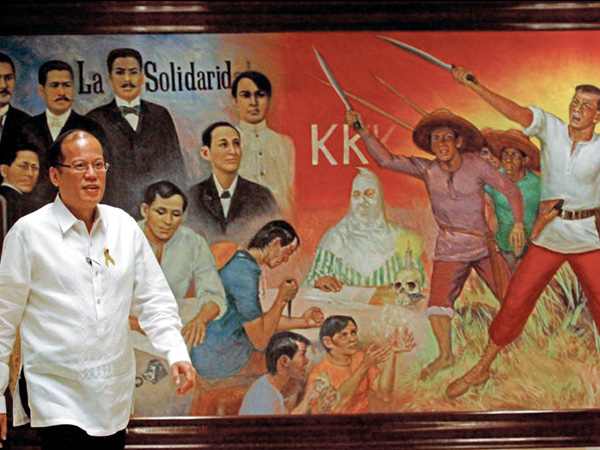 HEROES
HALL President Aquino arrives for a breakfast meeting with labor
leaders, businessmen and government officials in Malacañang on Tuesday.
MALACAÑANG PHOTO
HEROES
HALL President Aquino arrives for a breakfast meeting with labor
leaders, businessmen and government officials in Malacañang on Tuesday.
MALACAÑANG PHOTO
Granting a P125 across-the-board minimum wage increase for 40 million
workers is going to cost P1.43 trillion for a P9-trillion economy,
President Benigno Aquino III said Tuesday.
With this argument, Mr. Aquino ruled out the grant of such an
increase in his Labor Day speech, promising instead a P11.2-billion
educational assistance and a P1.1-billion skills upgrade of government
workers.
“I repeat, we’re taking out P1.43 trillion from an economy that is
worth P8 to P9 trillion,” Mr. Aquino told labor leaders and employers at
Heroes’ Hall in Malacañang.
He came up with the figure by multiplying P125 by 22 working days in a
month, then by 13 months in a year, and by the 40 million Filipino
workers.
“How can the businessmen recover this? Isn’t it that they’re going to
raise the prices of goods and services? Aren’t they going to cut costs
by laying off employees? Has anybody explained that there are 527,000
Filipinos who could lose jobs this year and next year if this is
implemented?” Mr. Aquino said.
4 goals
The government has four goals to address unemployment: Keep jobs,
create more jobs, upgrade skills of workers to find jobs that will give
them a “better future” and implement the laws to better the welfare of
workers, he said.
“Let’s be honest with one another. It’s clear that the proposed P125 increase runs counter to the first goal,” he said.
Mr. Aquino said the minimum wage, pegged at between $9 and $10, was
far better than Cambodia’s $2, Vietnam’s $2.4 to $3.21 and Indonesia’s
$3.05 to $5.27.
“If it gets higher, who would dare invest here in the country? This might even delay the growth of our economy,” he said.
Count blessings
The President indicated that workers should count their blessings,
saying that the government has managed to keep prices of basic
commodities stable despite spiraling fuel prices.
“In 2011, the wage increased by 5.24 percent, while inflation rose by
4.8 percent. That’s why we need a thorough dialogue and study of the
wage increase which we course through the Regional Tripartite Wage and
Productivity Boards. I’m now rushing their consultations with unions so
we can come up with a new wage order at the soonest possible time,” he
said.
The better strategy then, Mr. Aquino said, would be to invest in realistic, long-term programs.
Educational assistance fund
The President cited, for instance, the P11.2-billion educational
assistance fund program (EAFP) for 1.4 million members of the Government
Service and Insurance System (GSIS), and 200,000 members of the Social
Security System (SSS) for a four-year degree or technical and vocational
courses.
“Now the qualified members don’t have to hang on to loan sharks
(“5-6”) just so their children could study. There’s now a more practical
and fair alternative that Filipino workers can turn to invest in their
future,” he said.
Of the amount, P5 billion will be provided by the Department of
Budget and Management (DBM) out of “excess dividend collections”
remitted by government-owned and -controlled corporations (GOCCs), while
a counterpart fund of P6.2 billion will come from the GSIS and SSS,
Budget Secretary Florencio Abad said.
While all active GSIS members are covered by the program, only SSS
members with a monthly salary of P10,000 or less could avail themselves
of the assistance, Abad said in a statement.
Work scholarship
Mr. Aquino also cited the P1.1 billion fund for Work Scholarship
Program for the youth in IT-business process outsourcing, construction,
electronics, tourism and agriculture.
“We have ordered and funded the Tesda (Technical Education Skills and
Development Authority) to pinpoint the skills required by industries so
that a college education is not wasted.
We’re doing this to end the tragedy of our countrymen enrolling in a
good-sounding course only to graduate without a job waiting,” he said.
Advanced release
The DBM is spending an additional P2.7 billion for the advance
release of the fourth and last installment of the salary increase for
1.6 million government employees under the Salary Standardization III
program.
The advance release of the increase on June 1, instead of July 1, was
the “good news” announced by presidential spokespersons ahead of Labor
Day.
“June is the resumption of classes. The President thinks that if we
advance it to June 1 that will help the parents with their children’s
tuition,” Abad told reporters.
The President said he, Vice President Jejomar Binay and the Cabinet
secretaries were not availing themselves of the advance release of their
salary increase.
The fund will be drawn from the P19.5 billion dividends from GOCCs, according to Abad.
“I hope the private sector doesn’t begrudge us. The salaries of
government employees like us have lagged behind for some time. But I
repeat, out of sympathy, we—the Vice President and the Cabinet members,
and myself—will get our salary increase on schedule in July,” the
President said.
Labor leader’s concerns
The President heard pressing labor concerns straight from the horses’ mouth right inside his turf.
With the country’s top CEO listening, labor leader Jose “Sonny”
Matula assailed the growing industry practice of renewing workers’
contracts every five months to avoid regularizing them.
“Your Excellency, we’re bothered by the rampant contractualization,”
Matula, president of the Federation of Free Workers (FFF), said in a
speech during a brief dialogue between the President and labor
organizations at Malacañang’s Heroes Hall.
PAL layoffs
Matula said his group was apprehensive that Philippine Airlines’
decision to outsource its services, which precipitated the layoff of
thousands of airline employees, would further promote
contractualization.
“We sympathize with thousands of PAL employees who lost their jobs
after your office set aside the appeal of Palea (PAL Employees’
Association) to stop outsourcing the services of the PAL,” he said,
speaking on behalf of the labor unions.
If the profit-earning PAL is allowed to lay off employees, what would
stop other companies from doing the same in the name of “management
prerogative?” he wondered.
Worse, union employees and members are the first to take the ax under
such schemes, contrary to the spirit of the Philippine Development
Plan, Matula said.
Dilemma
Mr. Aquino, who spent 10 minutes to respond to Matula’s concerns
before delivering his Labor Day speech, admitted that he was caught in a
dilemma over the PAL labor issue, given the conflict in the Middle East
and Africa.
“If our countrymen in the Middle East had to be repatriated
immediately, we have to have the capability to do that. So the question
then was: Should we gamble on the capability of this company to continue
their flights, or on the fate of our countrymen?” he said.
Mr. Aquino said the Department of Labor and Employment (DOLE) had
issued Department Order 18-A which prohibits the renewal of contracts
every five months.
iPads for inspectors
To enforce this, he said the department was tapping 372 inspectors on
top of the present 224, to monitor contractualization in industries.
“As far as technology is concerned they can be given iPads so they
can immediately translate their findings to the DOLE central office,” he
said of the inspectors.
With regards to subcontracting arrangements, the President said the
industry could take a look at House Bill No. 4853, a consolidated
version of several bills promoting security of tenure.
This, however, might need some fine-tuning because of fears that it could lead to the layoff of 10.3 million workers, he said.
Also present at the dialogue were representatives of the Association
of Genuine Labor Organizations, Alliance of Filipino Workers, Alliance
of Progressive Labor, Alliance of Independent Hotel and Restaurant
Workers Union, Bukluran ng Manggagawang Pilipino, Lakas Manggagawa Labor
Center, Manggagawa Para sa Kalayaan ng Bayan, Pambansang Diwa ng
Manggagawang Pilipino, Philippine Meatworkers Alliance, Public Services
Labor Independent Confederation, Trade Union Congress of the Philippines
and Trade Unions of the Philippines and Allied Services.
Edgar Lacson, president of the Employers’ Confederation of the
Philippines, appealed for unity with the employees, saying “We’re not
your enemies.”
Originally posted: 1:39 pm | Tuesday, May 1st, 2012
Sunday, January 1, 2012
PolEco: 2011 New Years Message
Do we really believe that the country is progressing? What changes have been done with the economic policies that are burdening the masses. How much are the basic commodities now as compared with those of the last 10 years? The masses can speak that nothing has changed. Prices of basic commodities like food, electricity, water, oil, even basic services like health services (hospitals), are soaring high and being controlled by market forces, based on the law of supply and demand. Who benefits with this law of supply and demand? The big investors and capitalists, because they're the owners of the multi-million companies supplying almost all commodities. Everything is private now. Even the roads are considered private, because you have to pay in order to pass.
Subscribe to:
Posts (Atom)